There is a moment — and every parent has felt it — when a child goes quiet during a story. Not bored-quiet. Still-quiet. Like something being said in the pages is saying something about them. That moment is not an accident. It is the most important thing a story can do.
The Science Beneath the Story
Researchers in developmental psychology have spent decades studying why narrative — storytelling — is so central to how human beings make sense of their inner world. What they have found is profound: when children encounter characters who feel what they feel, their brains do not simply register information. They rehearse emotion.
Neuroimaging studies show that reading or listening to a story activates the same regions of the brain as actually living the experience. The prefrontal cortex — responsible for empathy, impulse regulation, and emotional reasoning — is genuinely exercised when a child follows a character through a difficult moment. Not just entertained. Trained.
Dr. Raymond Mar, a psychologist at York University, has shown that children who read more fiction score higher on measures of social cognition and empathy. The mechanism isn't magic. It's practice. Every story is a simulation of human experience — and the children watching, reading, and listening are running the simulation themselves.
"The right story doesn't just entertain a child. It gives them a vocabulary for what they're already feeling — and a path forward they didn't know was possible."
Why Emotional Vocabulary Matters More Than We Think
One of the quietest crises in childhood development is the gap between what a child feels and what they can name. Children experience complex emotional states long before language catches up. Frustration, shame, longing, grief, inadequacy — these arrive as big feelings with small words. When children cannot name what they feel, they act it out instead.
Stories give children a borrowed vocabulary. When Yeshua feels misunderstood because his gift looks different from what others expect, a child who has ever felt the same tension now has language: this is what it feels like when your gift doesn't fit the mold. When Levi realizes that character matters more than the scoreboard, a child absorbing that story practices the emotional reasoning behind it — even before they ever face a moment that demands it.
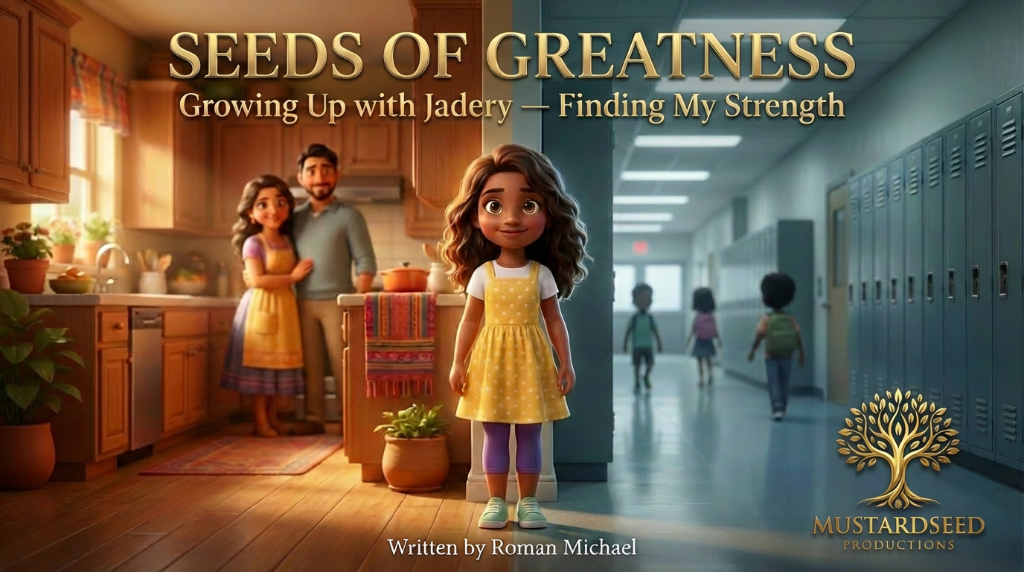
This is why the characters in Seeds of Greatness were built around specific emotional territories. Not arbitrary adventures, but deeply felt human experiences: identity, belonging, resilience, purpose, empathy, and courage. Each book is, at its core, an emotional education dressed in a story.
The Three Conditions That Make a Story Land
Not every story does this work. A story reshapes a child's emotional landscape when three conditions are met:
1. The child sees themselves in the character
Identification is the engine of emotional storytelling. When a child recognizes their own emotional reality in a character — their fear, their question, their secret hope — the story stops being external entertainment and becomes internal experience. This is why representation matters beyond politics: a child who has never seen a character who looks like them, moves like them, or questions like them is always watching from the outside. Stories in Motion was built to put children on the inside.
2. The character is allowed to struggle genuinely
Stories that resolve conflict too quickly or too easily steal the lesson. A child learns emotional resilience not by watching characters avoid difficulty, but by watching them move through it. The emotional beat that matters isn't the problem — it's the moment a character chooses to keep going anyway. That moment, rehearsed enough times, becomes a template a child carries into their own life.
3. The resolution is earned, not given
Children are extraordinarily sensitive to emotional authenticity. They know when a resolution feels true and when it feels handed to them. The most lasting stories are ones where the transformation — the moment the character understands something they didn't before — costs something. That earned resolution is the emotional model children internalize most deeply.
"Every story a child truly absorbs is a rehearsal for a moment in their real life they haven't reached yet."
How to Use Stories Intentionally as a Parent
The most powerful thing a parent can do is not simply put a good story in front of a child — it's staying present with them through it. Here are practical ways to turn story time into emotional development:
Ask feeling questions, not plot questions
After reading or watching together, resist the impulse to ask "what happened?" and instead ask: "How do you think Levi felt when that happened?" or "Have you ever felt the way Jadery felt in that moment?" You're inviting the child to practice emotional reasoning, not just recall events.
Let the story do the talking first
When a child is in the middle of a difficult emotional experience — a conflict at school, a fear they can't articulate — sometimes a story is more effective than a direct conversation. The story provides enough emotional distance for processing that a direct conversation might not. Read together. Let the book carry the first weight.
Name what you notice
When you see your child respond emotionally to a story — when they go quiet, when they laugh in recognition, when they ask to read it again — name what you notice. "I noticed you got really quiet when Messiah didn't get picked. What was going on for you?" That simple reflection turns a story moment into a connected one.
Return to the same stories repeatedly
Children request the same story over and over not because they've forgotten what happens, but because they are still mining it. Each time they return, they are at a different place emotionally — and the story meets them there differently. Repetition is not redundancy. It's depth.
The Seed Planted in the Right Season
There is a reason this company is called MustardSeed Productions. A mustard seed is almost invisible — smaller than a grain of rice — but it contains within it the potential to become one of the largest plants in the garden. The metaphor isn't about size. It's about what happens when a seed is planted in the right soil, at the right time, and tended with intention.
The stories we give children are seeds. The emotional experiences they rehearse in those pages are seeds. The vocabulary they borrow from a character who felt what they felt — that is a seed. Most of the time, we don't see it growing. But it is.
The goal of every book in the Seeds of Greatness series, every episode of Stories in Motion, every character page and journal entry here at MustardSeed Productions — is that a child somewhere absorbs something true about who they are and who they can become. That they walk through a story and come out the other side with something they didn't have before.
That is what stories can do. And as a parent, you are the gardener deciding which seeds to plant.
Seeds of Greatness · Stories in Motion
Meet the Characters Built to Build Your Child
Yeshua, Messiah, Levi, and Jadery — each crafted around a core emotional journey for children ages 3–8.